/ THE SHORT ANSWER
- 01Start with read-heavy work that has an existing human decision point.
- 02Make external sends, financial commitments, deletion and publication approval-only.
- 03Score the pilot on accepted outputs, review time, missed changes and actions avoided.
- 04Do not infer business impact from OpenAI's launch examples; measure it in your own workflow.
/ dotSuper point of view
The best early use case is not the most autonomous one. It is the one whose output a small team can check quickly and use to make a better decision.
Why small teams should be especially selective
Those examples show the intended breadth of the product.
They do not establish that a small business will get the same results without clean source data, clear ownership and enough time to review the work.
For a lean team, the hidden cost is not only the plan.
It is the manager's attention, source cleanup, permission management and recovery when the agent acts on stale information.
The first pilot should target a task that repeats often, is easy to check and can be reversed.
Five workflows worth a controlled pilot
Each begins with permitted read access and ends with a human reviewing the result.
Start with one, not all five.
First, maintain an internal decision log: watch an approved project plan and meeting notes, then flag decisions awaiting an owner.
Second, prepare a weekly supplier or market change brief with source links and an uncertainty column.
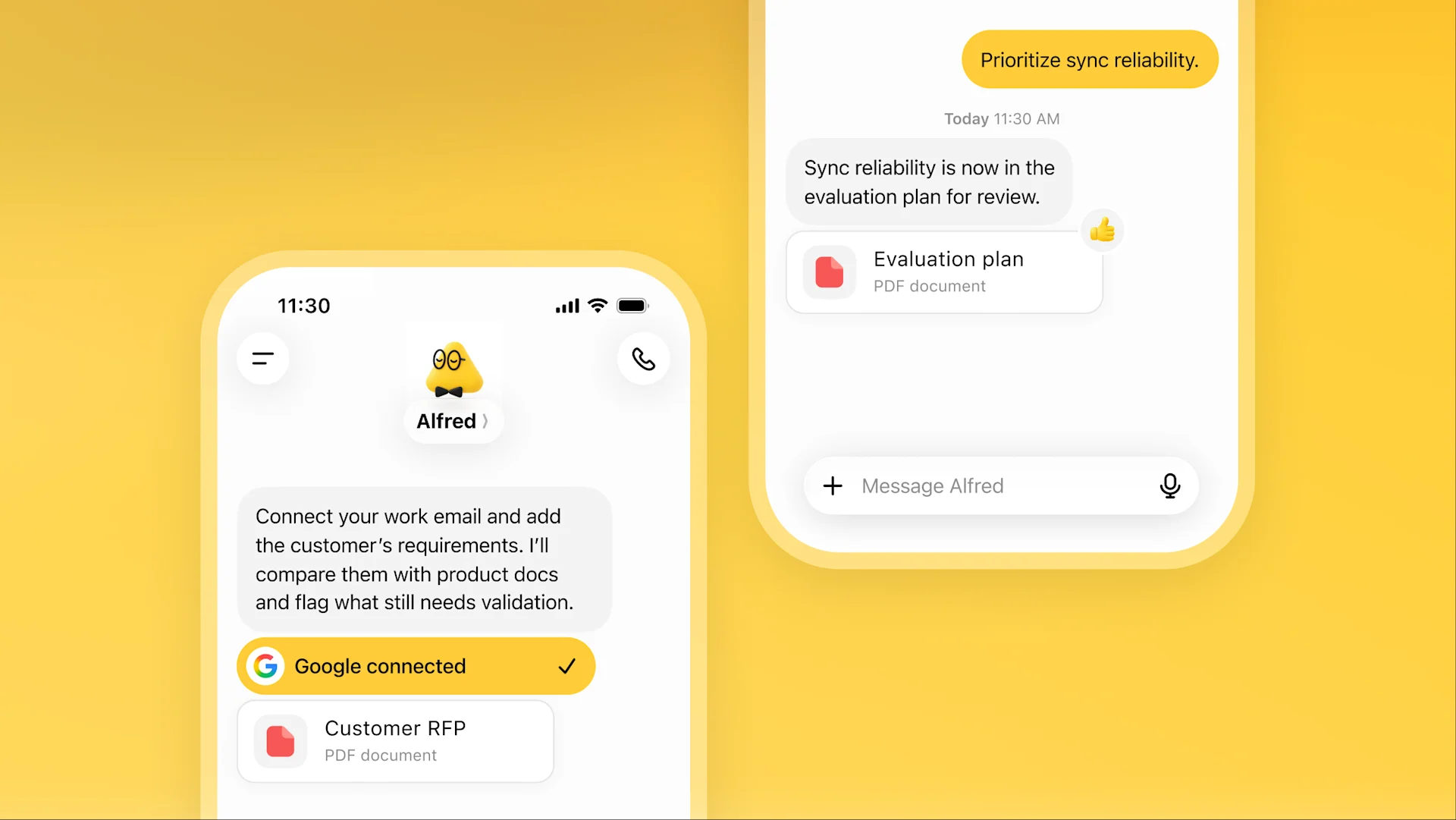
Third, triage an incoming RFP against approved product documentation and draft a gap list rather than a promise to the prospect.
Fourth, cluster customer feedback into themes and propose which issues need investigation.
Fifth, maintain a content research queue from approved sources, with claims and links prepared for an editor.
In every case, the useful output is a better human decision, not the agent's activity count.
| Pilot | Dot prepares | Person decides |
|---|---|---|
| Decision log | Changed items and unanswered questions | Priority and owner |
| Supplier brief | Cited changes and possible impact | Whether to contact a supplier |
| RFP triage | Requirement gaps against approved docs | What can be promised |
| Feedback themes | Clusters with representative examples | Which issue to investigate |
| Content research | Cited claims and draft angles | What to publish |
Four actions not to delegate in the first pilot
Do not let a new agent delete shared records.
Do not permit unreviewed customer promises or legal representations.
Do not give it the final publish button for public content.
Those actions have higher downside and can be difficult to reverse.
OpenAI describes app permissions, custom rules, action review and built-in safeguards.
These controls are important, but the vendor also warns that dots can make mistakes.
A custom rule is not an audit programme and a prompt is not a substitute for a responsible owner.
- Payments and purchase commitments
- Deletion of shared records
- Customer or legal commitments
- Unreviewed public publishing
A 30-day scorecard that measures value
Week two: let the dot prepare outputs against completed examples and count errors.
Week three: run fresh work with a human review gate.
Week four: compare accepted outputs, elapsed time, review effort and missed changes with the baseline.
A pilot is worth expanding only if the team accepts most outputs with little correction, the review burden falls, and no important change is missed.
If it merely generates more drafts and notifications, narrow it.
Record the errors and stop the scope that produced them before adding another integration.
| Metric | Why it matters | How to record it |
|---|---|---|
| Accepted output rate | Quality of usable work | Accepted outputs divided by all outputs |
| Review minutes | True human cost | Time spent checking and correcting |
| Missed or stale facts | Decision risk | Count material errors with source links |
| Time to decision | Business usefulness | Baseline versus pilot elapsed time |
| Unexpected actions | Boundary quality | Log every unplanned permission or action request |
Where outside help is useful
A business may need help selecting the first workflow, cleaning the source of truth, defining review roles, mapping permissions and deciding what success looks like.
Those choices are often harder than writing the first prompt.
dotSuper's role is to make the operating design explicit and testable.
If a Dot is not available to your team, the same task map, approval design and scorecard can be used with a simpler workflow or a human-led process.
The goal is a better outcome, not adoption of one vendor's agent.
What this page cannot conclude
- 01The five pilots and 30-day scorecard are dotSuper's recommendations, not OpenAI performance claims or a certified implementation method.
- 02We have not independently benchmarked Dots for SMB accuracy, savings or security. Results depend on task design, source quality and review practices.
- 03OpenAI's rollout, plan access and controls can change after 1 October 2026.
Sources
- 01Introducing dotsOpenAI · accessed Oct 1, 2026
- 02Meet dotsChatGPT Learn · accessed Oct 1, 2026
- 03Control your dotChatGPT Learn · accessed Oct 1, 2026
- 04How we build safety, security, and privacy into dotsOpenAI · accessed Oct 1, 2026
Our editorial standard · Found an error? Send a correction with its source.
/ CITE OR SHARE THIS GUIDE
Make the evidence easy to verify.
When you reference this guide, link to its canonical URL. That gives readers one stable place for the evidence, limitations and future updates.
dotSuper Research Desk. (October 1, 2026). ChatGPT Dots for SMBs: Five Workflows Worth Piloting, Four to Avoid. dotSuper. https://dotsuper.net/feeds/applied-systems/chatgpt-dots-smb-pilot-use-cases